
What Lean actually looks like in a dental front office
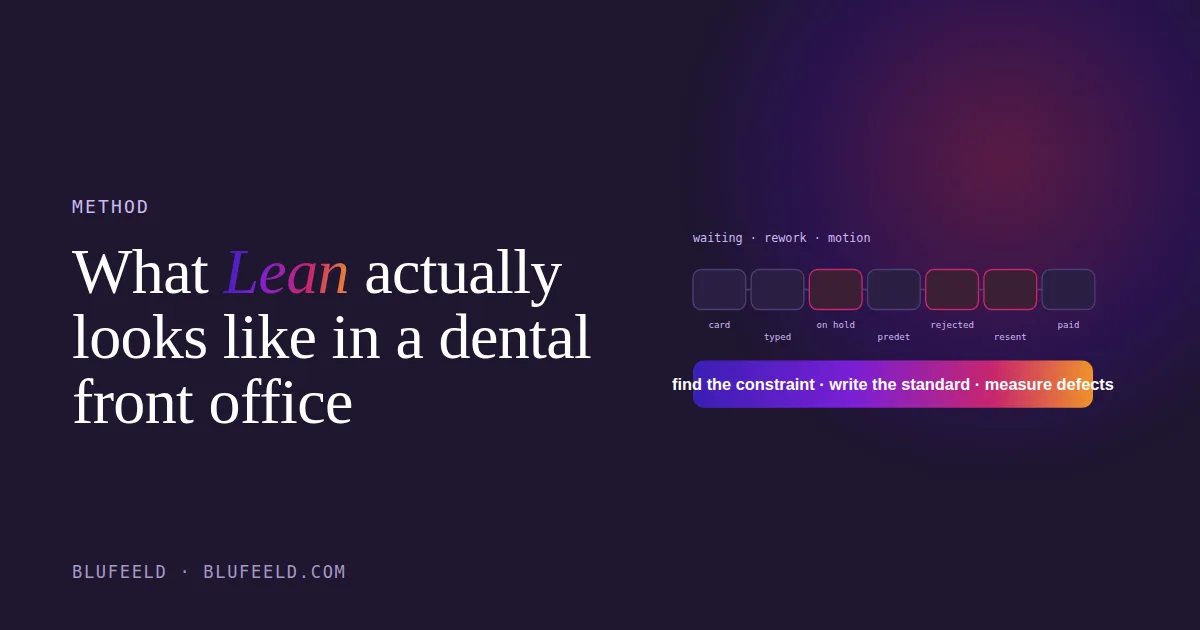
Lean has a reputation problem in dentistry. It arrives with a consultant, a slide about Toyota, and a vocabulary nobody at the front desk will ever use. Then the consultant leaves, and the office goes back to doing what it did. That is not Lean’s fault. It is what happens when the method is presented instead of applied.
I used Lean and Six Sigma to design the FlexTeam Method™, and I still use them on every engagement, but you will not find the words on my homepage, because a dentist does not need the theory. This post is the theory anyway, for the owner who wants to see the thinking. I will take one process every practice has, insurance verification, and walk through it the way I would on site.
Start by watching, not fixing
The first Lean habit is the one most people skip: go and look. Not the procedure as the office manager describes it, the procedure as it actually happens, from the moment a new patient’s insurance card is photocopied to the moment the claim is paid. I sit beside the person who does it, for a day, and write down every step, every wait, and every time something goes backwards.
Here is what that typically produces for insurance verification in a practice with one person doing it:
- Card copied at check-in. Details typed into the PMS later, often the next morning.
- Eligibility checked by phone for the insurers whose portals are unreliable. Twenty minutes on hold is normal. The coordinator does other things while holding, so the call is interrupted, and sometimes restarted.
- Predetermination sent after the treatment plan is finalised, which is after the patient has left, which means a call to the patient later to confirm the appointment once the answer comes back.
- Claim goes out with the subscriber’s date of birth wrong because it was read off a photocopy. Rejected. Corrected. Resent. Two weeks lost.
- Nobody checks the aging report until the month-end, when the pile is large enough to be a project.
None of this is anyone’s fault. It is what a process looks like when it was never designed, only accumulated.
Name the waste
Lean’s core move is to separate the work that produces something from the work that only produces waiting, rework, or motion. In the list above, the actual value is small: confirm coverage, send the estimate, submit a correct claim, follow up. Almost everything else is one of three kinds of waste.
Waiting. On hold with the insurer. Waiting for the treatment plan. Waiting two weeks for a rejected claim to come back. Waiting until month-end to look at aging.
Rework. The claim resent because of a typo. The patient called back because the predetermination arrived after they left. Six Sigma would call the typo a defect and ask for its rate; in most practices nobody knows it, and when we measure it, it is higher than the owner guessed.
Motion. The card copied, then typed. The same information touched three times by the same person. The walk to the operatory to ask whether the crown is covered.
Once the waste has a name, the fix is usually obvious to the person doing the job. They knew all along. Nobody had ever asked them to stop and look.
Find the constraint
Every process has one step that sets the pace for all the others. In insurance verification it is almost always the same thing: one person, who is also answering the phones. Her capacity is the ceiling. You can speed up everything around her and the throughput does not change, because she is still the only one who can do the work and she is still being interrupted.
This is where the FlexTeam Method™ came from. The Lean answer to a constraint you cannot remove is to protect it and to add flexible capacity around it. Protect it: the verification block is a calendar appointment, phones covered by someone else, no interruptions. Add capacity: a second person cross-trained to do verification to the same standard, on a rotating schedule so the skill stays current. The constraint stops being a person and becomes a step, and a step can be improved.
Write the standard
Lean’s most underrated idea is standard work: the one best-known way to do the job, written down, followed by everyone, and changed only on purpose. In a dental office this is a one-page procedure for insurance verification, written by the coordinator, not by me: which insurers to check by portal and which need a call, what to capture at check-in so nothing is re-keyed, when the predetermination goes out (before the patient leaves, not after), and what “done” looks like.
The standard lives in the task system, attached to the recurring task, so whoever is on insurance that week follows the same page. That is the whole mechanism behind a new hire being useful in three weeks instead of two months. It is also why task management is not optional in this method; without it the standard is a document in a drawer.
Measure defects, not volume
Six Sigma’s contribution is the discipline about numbers. A practice already measures production and collections, which are volume measures: they go up when the office is busier, whether or not anything got better. The numbers that tell you whether the process improved are the defect measures:
- Corrections: claims that had to be fixed and resent. The rework rate.
- Adjustments: billed work written down because the coverage was not what the office thought. The cost of a verification that did not happen or was wrong.
- Collection rate: what was billed versus what was actually collected. The yield of the whole process.
- Days to useful for a new hire on this task. The proof that the standard is real.
Those are the figures I report from Vancouver (adjustments down 70%, corrections down 50%) and they are the figures I would report from any practice, because they cannot be inflated by a busy month. Total collections doubled there too, but that is the outcome, not the measure. If a consultant shows you only production going up, ask what happened to corrections.
Then change one thing, and check
The improvement cycle in Six Sigma is define, measure, analyse, improve, control. Translated to a front office: agree what “insurance verification” includes, count the defects for a month, watch the process and name the waste, change the constraint and write the standard, and then keep measuring so it does not drift back. That is the five-step engagement on my homepage, with the vocabulary removed. The last step, control, is the one most consultants skip, because it means staying until the team runs it without you. It is the difference between a report and a result.
Why the words stay off the homepage
Because a dentist does not need to know the method is Lean to benefit from it, and because the profession has met too many people who knew the vocabulary and had never sat at a front desk. The test of the thinking is not whether I can name the seven wastes. It is whether the office manager can take two weeks off. If you want to know how close your practice is to that, the twelve-question assessment is, in Six Sigma terms, a defect count. It takes four minutes.
