
Breaking the pyramid: cross-training and rotating schedules in a dental office
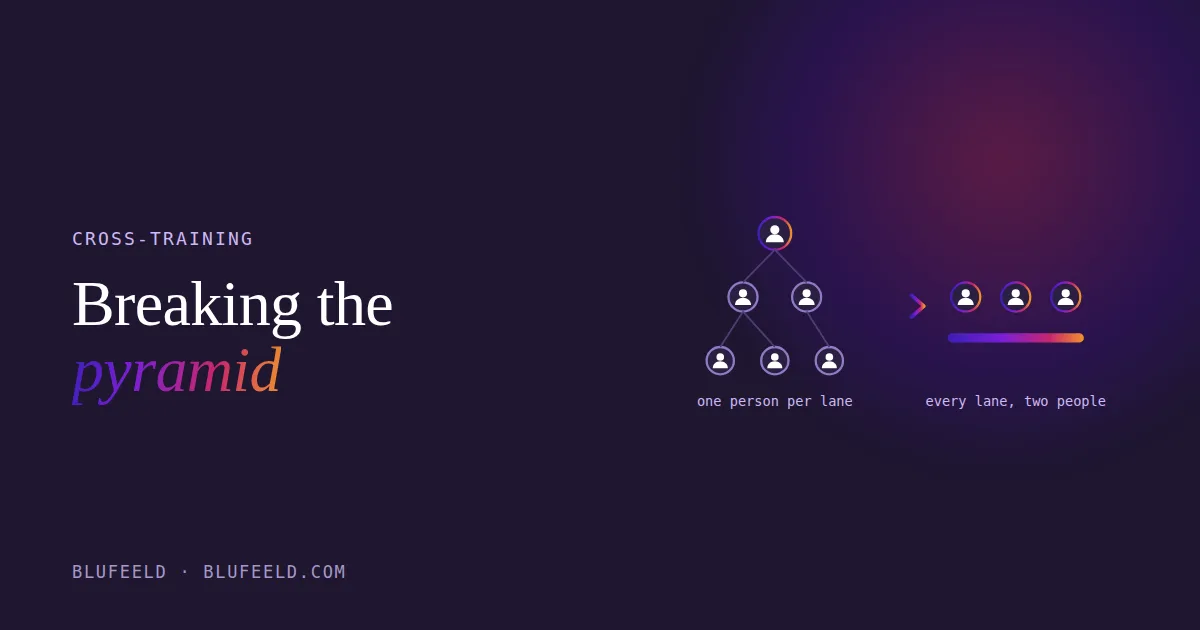
It is a Wednesday. Your insurance coordinator calls in sick. Claims pile up, a patient at the desk wants to know why her predetermination has not come back, and the front desk is already on two phones. Nobody else knows how to do her job, so nobody does it. The chairs are full and the office is running badly, and the production report will never show it.
Most dental offices are built this way, and most owners have stopped noticing. This post is about the structure that causes it and the two changes that remove it: cross-training, and a rotating schedule that keeps the cross-training alive.
The pyramid
Draw the org chart of a typical practice and you get a pyramid. The dentist at the top. The office manager under them. Below that, one person per function: reception, scheduling, insurance, billing, recall. Each person owns a lane and gets very good at it. Nobody else learns it, because there is never a slow week to learn it in.
The pyramid is efficient on a normal day. The problem is that it has a single point of failure at every level. When one person is away, their lane stops. When one person leaves, their lane has to be rebuilt from scratch by whoever is left, usually while the new hire watches.
You can see it in four places without looking hard:
- Vacations become outages. The week the scheduler is away, the hygiene column has gaps nobody saw coming.
- Training means shadowing. A new hire sits beside someone for two months and inherits the workarounds along with the job.
- The owner is the escalation path. Every operational question the team cannot answer ends up in the operatory doorway.
- Nobody can take a real holiday. The office manager checks email from the beach because she is the only one who knows.
None of this is the team’s fault. They are doing exactly what the structure asks of them. It is a design problem, and design problems get fixed by changing the design.
Cross-training: every front-office role, learned by more than one person
Cross-training means that for every administrative function in the practice, at least two people can do it to a working standard without help. Not “has seen it done.” Can sit down on a Wednesday and send the predeterminations.
The scope is the front office: reception, scheduling, insurance verification and predeterminations, billing and collections, recall and reactivation, patient communication. Clinical roles are not part of it. A hygienist stays a hygienist.
Two things make cross-training stick, and most practices that try it skip both.
Write the procedure down first. You cannot train two people on something that lives only in a third person’s head. Before anyone learns insurance, the person who does insurance writes down how she does it: which insurers need a call before the claim goes out, what she checks on the EOB, where the predetermination log lives. That document becomes the training. It also becomes the thing a new hire follows in week one, which is how the practices I work with get a new front-desk hire useful in three weeks instead of two months.
Put the work in a system, not a memory. Recurring tasks live in a task list with an owner and a due date, so when the owner changes, the list does not. I wrote about that separately in The process lives in the system.
Rotating schedules: what keeps the training alive
Cross-training without rotation decays. Someone learns insurance in March, does not touch it until the coordinator’s holiday in August, and by then the insurers have changed their portals and she has forgotten half of it.
A rotating schedule fixes that by making the second person do the job regularly, not in emergencies. The version I use is weekly: Monday, one person is on insurance and another is on the front desk. The following week they swap. Over a month, everyone has done everything at least once. Skills stay current because they are used, and the handoff between weeks is written down in the task system, not remembered.
Rotation has a second effect that is easy to underestimate. The person who has done insurance for a week understands why the front desk should collect the subscriber ID at booking. The person who has been on the phones understands why insurance needs the treatment plan before the patient leaves. The lanes stop blaming each other because everyone has driven in both.
How to start without breaking the office
Do not rotate everything in week one. The sequence that works:
- Pick the two roles that hurt most, usually insurance and scheduling, because those are the ones that stop when one person is out.
- Have the current owner of each role write the procedure. One page each. Not a manual. What they actually do, in order.
- Pair for two weeks, then rotate for a month. The second person works the role alongside the first, then takes it alone for a week while the first is available for questions.
- Fix the procedure as you go. Every question the second person asks is a gap in the document. Close it the same day.
- Add the next role only when the first two run without you.
Measure it with things you already have, not with survey scores. Did production hold the week someone was away? Did claim corrections go down? How many days until the last new hire worked a shift alone? Those three numbers tell you whether the pyramid is gone.
“That’s not my job”
Someone will say it. It is usually the person who has been carrying the most, and the honest answer is that their job gets easier, not smaller. The office manager who is the only one who can build the schedule is not powerful; she is trapped. She cannot take a week off without the office wobbling. Once two other people can build it from the written procedure, she can. In my experience that is the moment the resistance ends.
The other objection is time, and it is real: the first month costs a few hours a week of paired work. There is no downtime and no closed day. The office keeps seeing patients while it happens.
Cross-training and rotation are two of the five parts of the FlexTeam Method™. The other three, task management, communication, and security, are what make them hold. The full picture, and what it did in the Vancouver practice where I deployed it, is in The FlexTeam Method™.
