
The CrossDesk Method™: how a dental office keeps running when a person leaves
It is a Wednesday. Your insurance coordinator calls in sick. By ten o’clock there are three predeterminations nobody knows how to send, a patient at the desk asking why her claim was denied, and a hygienist waiting to find out whether the crown she just diagnosed is covered. The person who knows is at home with the flu.
Nothing on the production report will show it. The chairs were full. But the office ran badly all day, and it will run badly again the next time she is away, because the practice does not know how to do her job. She does.
That is the problem the CrossDesk Method™ was built to remove. This post is what it is, how it works day to day, what it did in the one practice where I have deployed it in full, and what it costs a team to adopt.
The pyramid, and why it fails quietly
Most dental offices are organized as a pyramid. The dentist at the top, the office manager under them, and one person per function below that: reception, scheduling, insurance, billing. Each person owns a lane. Each person gets good at that lane. Nobody else learns it.
It works, right up until it does not. A vacation becomes an outage. A resignation becomes a crisis. A new hire spends two months shadowing whoever is left and inherits the workarounds along with the job. And the owner, who went to school to do dentistry, ends up as the only person who can answer an operational question.
The pyramid is not a people problem. The people are doing exactly what the structure asks. It is a design problem: the practice’s operating knowledge lives in individual heads instead of in the practice. I wrote about the shape of it in Breaking the Pyramid. This post is about the replacement.
What the CrossDesk Method™ is
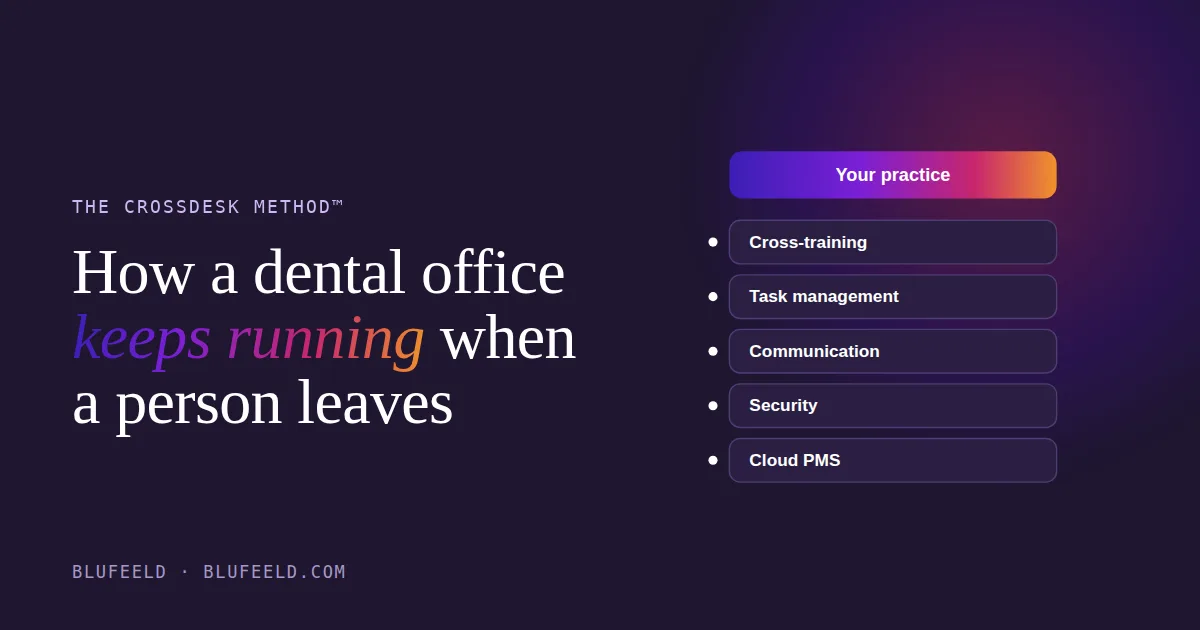
It is an operating layer for the front office, made of five parts. Each one is ordinary on its own. Together they move the knowledge out of people and into the practice.
1. Cross-training with a rotating schedule
Every front-office role is learned by more than one person, and the team rotates through the roles on a schedule. Monday, one person is on insurance. Next week she is on the front desk and someone else is on insurance. Skills stay current because they are used, not because they were covered in training once.
Clinical roles do not rotate. A hygienist is a hygienist. The rotation covers reception, scheduling, insurance verification and predeterminations, billing and collections, recall, and patient communication.
2. Task management
Rotation only works if the work is visible. Every recurring task in the office, from the morning huddle checklist to the end-of-month insurance aging review, lives in a task system with an owner, a due date, and a written procedure attached. When the person on insurance changes on Monday, the work does not change. It is the same list, with the same steps, assigned to a different name.
This is also how a new hire becomes useful in three weeks instead of two months. They follow the list. They do not have to shadow anyone to find out what the job is.
3. Communication
One channel for the team, so the handoff between Monday’s insurance person and Tuesday’s is written down, not remembered. And more than one channel for patients, so the phone is not the only way in and the front desk is not the only bottleneck. Confirmations, recall, and routine questions run on text and email; the phone is for the conversations that need it.
4. Security
Rotation multiplies the number of people who touch each system, which is why it cannot run on shared logins. A practice-wide password manager gives every team member their own credentials for the PMS, imaging, insurance portals, and email, with access granted and removed centrally. When someone leaves, their access is gone the same day. And there is an audit trail of who did what, which is the standard your regulator expects — PHIPA in Ontario, HIPAA in the US.
5. Cloud PMS, where it fits
Most offices still run their practice management software on a server in a closet, bought, patched, backed up, and secured by the practice. A cloud PMS moves that to the vendor, lowers the capital and operating cost, and lets the team work from anywhere with a login. It is not right for every office. Where an established practice has deep integrations with imaging and equipment, it may not be worth the migration. I compare the two models in Dentrix vs Curve.
What happened in North Vancouver
I deployed the full method in a North Vancouver practice that was eight months old. Young enough that nobody thought it had a problem yet, and already running on workarounds: one person building the schedule, one person who understood the insurers, shared logins, and a training process that consisted of sitting next to someone.
After the method went in, with the same staff and the same chairs:
- Adjustments down 70% — write-downs on billed work
- Corrections down 50% — re-work on claims and records
- Total collections doubled — money collected, not just billed
- New-hire training down to three weeks — from two months
- Surgical procedures up 100% — with the same resources
These are figures from a single practice, and I present them as that. Adjustments and corrections are process measures: they do not improve because a practice gets busier. They improve because the claim went out right the first time and someone owned the follow-up. Collections followed.
What it takes
Two honest things about adoption.
It is easiest in a new practice, before the habits set and before one person has become the whole process. That is where the North Vancouver practice was. In an established office I do not rip out systems a team has run for years. I start with the problems you already feel, fix those, and put the fuller system in once the results are visible and the team trusts the process. That takes longer, and it is the right order.
Someone will say “that’s not my job.” Usually the person who has been carrying the most. The answer is that their job gets easier, not smaller. The office manager who is the only one who can build the schedule is not powerful; she is trapped. She cannot take a week off. Once two other people can build the schedule from the written procedure, she can.
The practice supplies the team’s time, a few hours a week for the first month, mostly in the rotation itself. There is no downtime. The office keeps seeing patients throughout.
Where your practice depends on one person
If you want to know how much of your office currently lives in someone’s head, I built a twelve-question assessment. It takes about four minutes, and you get a score and a written readout on the page whether or not we ever speak.
Or email me directly: info@blufeeld.com. I am based in Toronto and work with practices across Canada and the US.
