
The process lives in the system: task management for the dental front office
Ask a front desk how they know what needs doing today and you will get a tour: a sticky note on the monitor, a notebook by the phone, a whiteboard in the back, a text thread with the office manager, and a lot of “I just remember.” It works, in the sense that most things get done. It also means that when the person who “just remembers” is away, the practice finds out what she was remembering by watching it not happen.
Task management is the least glamorous of the five parts of the FlexTeam Method™ and the one the others depend on. This post is what it looks like in a dental office, what it changes, and how to bring it in without turning the team against it.
What “the process lives in the system” means
Every recurring piece of front-office work is a task in a shared system, with three things attached: an owner, a due date, and the written procedure for doing it. Not a manual; one page, in the order the person actually does it.
Some of what goes in, from a real front office:
- Daily: morning huddle checklist, confirm tomorrow’s patients, work the unscheduled-treatment list, end-of-day deposit
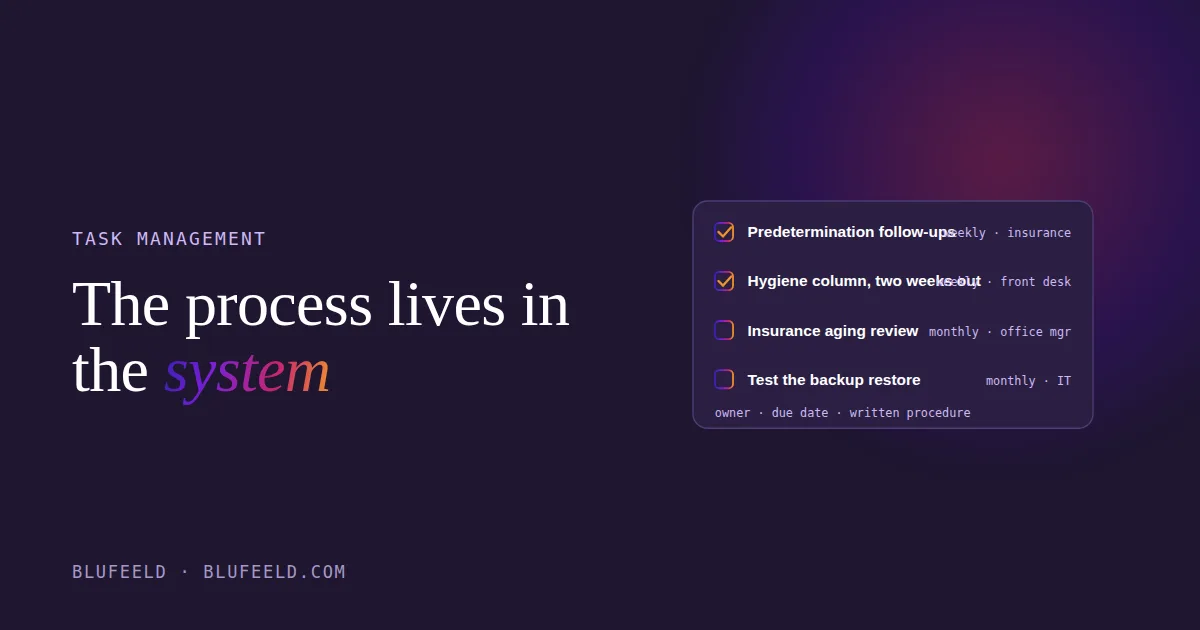
- Weekly: predetermination follow-ups, hygiene column two weeks out, recall calls, supply order
- Monthly: insurance aging review, statement run, equipment maintenance log, test the backup restore
- When it happens: new-patient intake, staff offboarding checklist, “the PMS is down” procedure
The recurring ones create themselves. Nobody has to remember that the aging review is due; it appears on the first of the month with the procedure attached and a name on it.
What changes
Rotation becomes possible. When the person on insurance changes on Monday, the work does not. It is the same list with the same steps, assigned to a different name. Without this, cross-training decays into “ask Maria.”
A new hire is useful in weeks, not months. They follow the list. They do not have to shadow someone to find out what the job is, and they do not inherit the workarounds, because the procedure was written by the person who knew the right way, not copied from whoever was sitting nearest.
Handoffs are written, not remembered. A task that is half done at the end of a shift has a note on it. The next person picks it up from the note. The morning conversation that used to start with “where did you get to on the Sun Life claims” stops happening.
The owner stops being the escalation path. “What do we do when a patient disputes a balance” has a written answer. The question stops arriving at the operatory door.
Bottlenecks become visible. If the predetermination follow-ups are always overdue, the system shows it. That is information about the workload, not about the person, and it is how you find out that insurance needs two people before the coordinator burns out.
Accountability without surveillance
This is where task systems fail in practices, and it is a leadership problem, not a software one. A task list that records who did what and when can be used to find out where the process is broken, or to find out who to blame. Teams can tell which one their owner is doing within a week.
The version that works: the data is used to fix the procedure and rebalance the load, never as evidence in a performance conversation that was not already happening. Overdue tasks are a question about the workload first. The team is asked how to make the list better. And the checklist never becomes more important than the patient in front of the desk.
Say this out loud when the system goes in. The team will be listening for it.
How to bring it in
- Start with one role’s recurring tasks. Insurance is the usual choice because it has the most steps and the most hidden knowledge.
- Have the person who does it write the procedures. Not the owner. The person who knows which insurers need a call first.
- Run it alongside the sticky notes for two weeks. Then take the sticky notes away.
- Add the next role when the first one runs without reminders.
- Review the list monthly. Delete tasks nobody does, fix procedures that raised questions, and rebalance owners.
The software matters less than people expect. Any shared task tool with recurring tasks, assignees, due dates and attachments will do; the one your team will actually open on a phone is the right one. What matters is the procedure attached to each task, because that is where the practice’s knowledge moves from a head to a place the whole team can reach.
If you want to know how much of your office currently lives in someone’s memory, questions three, four and six of the twelve-question assessment are the ones about this.
